
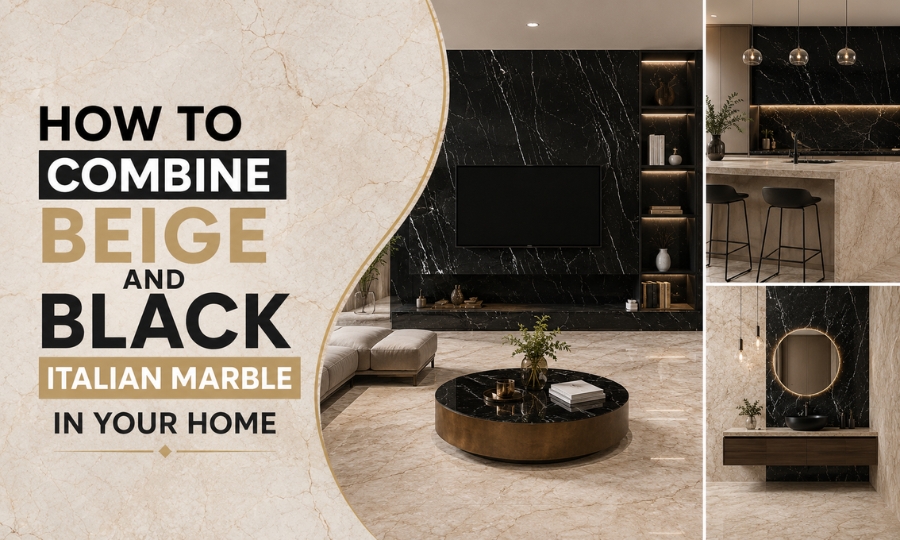
Combining beige and black Italian marble creates timeless interiors that balance warmth, contrast, and sophistication. With thoughtful design, proper installation, and quality sourcing, homeowners can achieve elegant, durable spaces that remain stylish for years.
Key Takeaways
- Beige and black Italian marble create balanced, timeless interiors with striking visual contrast.
- Follow the 70–30 design rule to maintain brightness and elegance.
- Match marble varieties by finish, veining, and thickness for consistent results.
- Proper installation techniques improve durability and long-term appearance.
- Source both marble together for better quality, uniformity, and project efficiency.
A report by the Institute for Studies in Industrial Development suggests that India’s construction sector is one of the country’s major economic drivers, contributing significantly to Gross Value Added (GVA) and 9% of the country’s GDP. Simultaneously, premium residential developments across metropolitan cities continue to increase demand for high-quality natural stone finishes.
Italian marble is highly associated with premium homes, luxury hotels, and elegant commercial interiors. In India, homeowners are increasingly moving beyond using a single marble colour throughout the property. Instead, they are combining complementary tones to create interiors that feel sophisticated, personalised, and timeless.
In this regard, the combination of beige Italian marble and black Italian marble emerged as a popular option. While beige introduces warmth and openness, black adds contrast, drama, and architectural depth. If balanced correctly, the pairing creates interiors that are both luxurious and practical.
Why does the Colour Combination Work?
A well-designed home balances warmth, sophistication, and practicality. Combining contrasting marble tones creates luxurious interiors without overwhelming the space. Whether you’re building a new home or renovating an existing one, understanding how to coordinate colours, finishes, and layouts helps you achieve a timeless aesthetic that complements modern Indian lifestyles.
The success of combining beige Italian marble with darker marble lies in visual balance. While beige reflects natural light, making interiors appear brighter and larger, black introduces definition, highlights architectural features, and creates premium focal points.
Executed correctly, this high-contrast pairing yields clear architectural and spatial advantages:
- Strong visual contrast
- Better zoning in open layouts
- Greater design flexibility
- Timeless elegance that remains fashionable for decades
Rather than competing, these colours complement one another when proportioned correctly.
The Design Rules for Balancing Warm Beige and Deep Black Marble
Achieving the perfect balance between deep black marble and warm beige requires deliberate aesthetic restraint to prevent a luxury space from feeling visually fragmented or unintentionally dark.
Sizing Your Space with the 70-30 Composition Standard
Interior designers often recommend the 70-30 design rule (70% lighter surfaces and 30% darker accent surfaces), as it prevents darker marble from overwhelming the room while still allowing it to become a striking design element.
This balance created through staircase risers, black borders, feature walls, bathroom vanity, or TV backdrop empowers luxury without making interiors feel smaller.
Focus on Textural Contrast
To soften the naturally sleek and cold feeling of black and beige stone, layer rich, tactile fabrics like linen, wool, or boucle into the space. Additionally, incorporating warm wood tones like natural oak or walnut acts as an organic mediator that beautifully balances the high contrast.
Room-by-Room Design Ideas
Here are some room-by-room design ideas for you before you opt for the combination.
Living Room
Design Objective: Maximise light reflection across the floor plane while anchoring large, conversational furniture layouts.
Primary Flooring (70%): Highly polished, large-format slabs.
Accent Planes (30%): Polished beige marbles applied to double-height TV backdrops, fireplace surrounds, or custom-built coffee table tops.
Contrast Strategy: The highly reflective cream flooring bounces ambient natural light to make the room feel larger, while the dark vertical TV backdrop draws the eye, establishing a clear structural focal point without enclosing the space.
The living room is often the best place to showcase premium marble. Use beige Italian marble options like Malisha Beige Italian Marble or Crema Nova Italian Marble for flooring to maximise brightness.
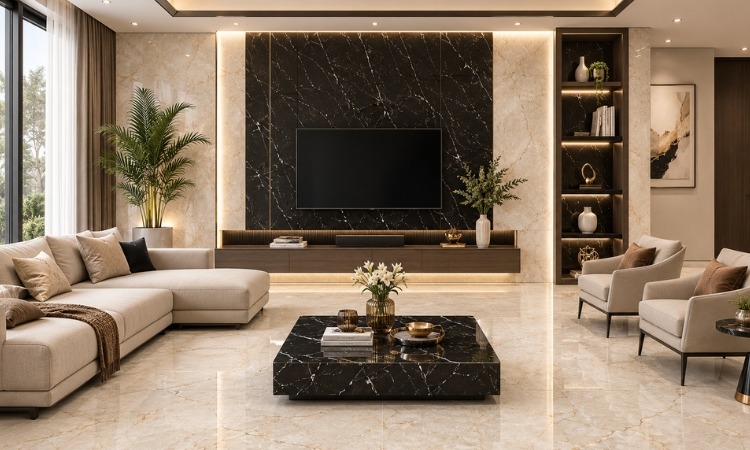
However, you can use black Italian marble through TV feature walls, coffee table tops, decorative niches, and window surrounds.
Instead of visual heaviness, it creates an elegant outlook.
Kitchen
Design Objective: Balance warm, welcoming lighting with high-durability surfaces that mask common kitchen splatters.
Primary Surfacing (70%): Natural, slip-resistant honed beige flooring.
Accent Planes (30%): High-density black marble countertops, matching full-slab splashbacks, and kitchen island under-claddings.
Contrast Strategy: Acidic culinary ingredients and oil splatters can etch or stain lighter natural stone. Utilising dense, highly polished dark marble for active countertops elegantly conceals minor spots, while the warm beige flooring reflects under-cabinet LED arrays to keep the workspace beautifully illuminated.
Modern Indian kitchens increasingly use darker surfaces, since they conceal turmeric spills, oil splatters, and minor food stains better than stark white materials.
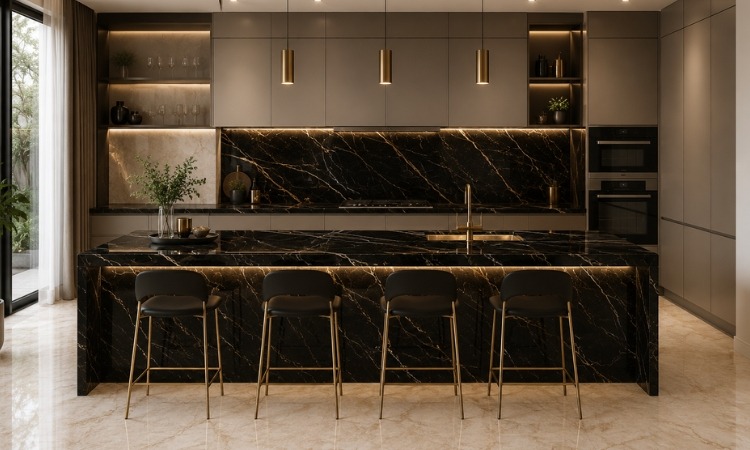
Here’s what an effective combination includes:
- Beige flooring
- Black countertop
- Matching backsplash accents
- Brass or matte black fixtures
The warm floor balances the bold countertop while creating a refined contemporary appearance. You can opt for Black Marquina Italian Marble or Golden Galaxy Italian Marble for the best contrast and design.
Bathrooms
Design Objective: Establish an elegant, high-contrast zoning layout that clearly separates wet and dry utility areas.
Primary Surfacing (70%): Soft, delicate beige marble wrapping the dry-zone floor, outer wall claddings, and secondary vanity surfaces.
Accent Planes (30%): Black marbles installed along the shower wet wall, matching built-in product niches, and floating vanity splashbacks.
Contrast Strategy: Concentrating the dark stone solely within wet zones creates a high-contrast recess that visually frames the lighter vanity area, maximising the perceived depth of standard bathroom layouts.
Looking for a spa environment in bathrooms? Well, the combination of beige and black Italian marble can create a dramatic contrast.
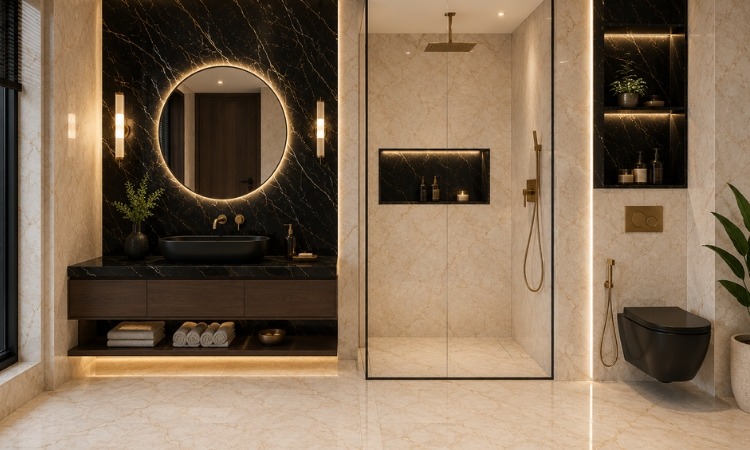
Recommended Use
- Beige flooring
- Black vanity wall
- Black shower niche
- Beige shower walls
- Soft warm lighting
This combination creates the feel of a luxury hotel while maintaining brightness.
Staircases
Design Objective: Turn a functional building transition into a striking, mathematically balanced structural sculpture.
Primary Treads (70%): Clean, slip-resistant honed beige marble flat steps (treads).
Accent Risers (30%): High-gloss black marble vertical risers and matching perimeter skirtings.
Contrast Strategy: This layout serves both an aesthetic and functional purpose. The stark contrast between the light horizontal treads and dark vertical risers acts as an organic visual guide, significantly improving edge tracking and safety, while accentuating the elegant geometry of the steps.
Since staircases naturally attract attention, the combination of black and beige Italian marble can create a stunning and visually appealing look.
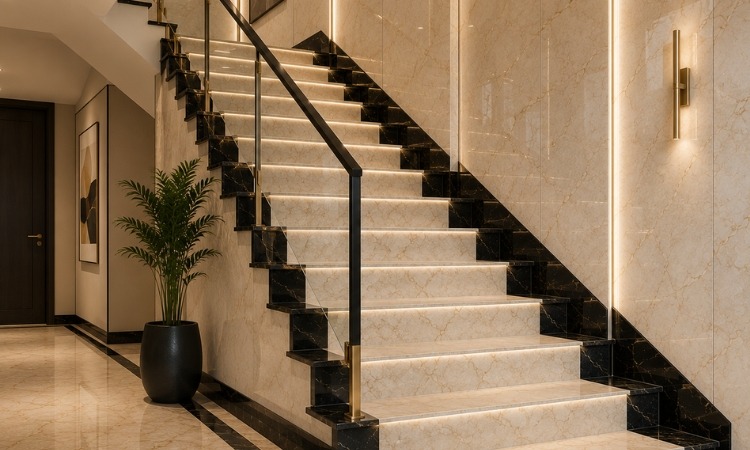
Here’s what you need to consider:
- Beige treads
- Black borders
- Black skirting
- Beige wall cladding
The contrast highlights the architectural geometry of the staircase.
Bedroom
Design Objective: Cultivate a serene, rest-focused environment without sacrificing premium architectural character.
Primary Surfacing (70%): Understated, soft-veined beige marble flooring.
Accent Planes (30%): Minimally-veined black marbles restricted to bedside table tops, visual headboard paneling, or slim, integrated wall-mounted border inlays.
Contrast Strategy: To maintain a calm, low-arousal atmosphere, black marble is kept away from your primary line of sight when resting in bed. Instead, it is utilised in small, highly polished accents to elegantly anchor bedside lighting and rich textile surfaces (such as linen or velvet headboards).
Bedrooms are often expected to remain calm and composed. In that case, here’s what you can use instead of extensive dark marble.
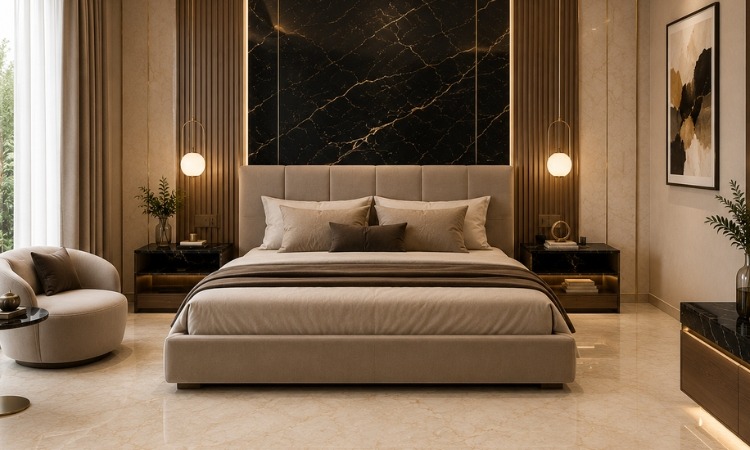
- Beige flooring (Suggested Marble Option: MONALISA BEIGE ITALIAN MARBLE)
- Black bedside tabletop
- Headboard feature wall
- Decorative wall panels
This creates a sense of sophistication without making the room feel enclosed.
Material Coordination: Selecting the Right Stone Varieties
Systematically curating your stone selection involves evaluating more than basic surface colour; it requires analysing the physical compatibility and structural properties of the slabs.
Creating a balanced luxury interior begins with selecting marble varieties that complement each other in appearance and performance. Premium beige Italian marble offers warm undertones that brighten spaces, while black Italian marble introduces depth, contrast, and visual definition. Instead of pairing stones based only on colour, homeowners should also compare veining direction, mineral composition, finish, and slab dimensions.
For the best long-term results, source both materials from the same importer. It improves batch consistency, simplifies fabrication, and reduces the risk of visible shade variations after installation.
The Ultimate Italian Marble Pairing Matrix
The following combinations create timeless, balanced interiors suitable for modern Indian homes.
| Beige Italian Marble | Black Italian Marble | Best Application | Design Benefit |
| Crema Nova | Marquina Black | Living Rooms | The soft cream background contrasts with bold white veining, creating a timeless luxury aesthetic. |
| Brescia Aurora | Black Rose | Staircases & Landings | Rich beige tones paired with elegant dark veining create refined transitions between floors. |
| Rosalia Beige | Bronze Armani | Bedrooms | Soft beige hues and bronze-black textures create a warm, sophisticated ambience. |
| Monalisa Beige | St. Laurent (NSL/St. Laurent) | Feature Walls | The subtle elegance of Monalisa Beige balances the luxurious gold veining of St. Laurent marble. |
Table: Beige and Black Italian Marble Pairing
High-Impact Applications in Indian Luxury Homes
The combination of beige and black Italian marble works exceptionally well in spacious villas, luxury apartments, and premium commercial interiors, where visual contrast enhances architectural detailing.
The Grand Entry Foyer: Reimagined Geometric Inlays
Luxury foyers often prefer clean geometric layouts over heavily ornamented traditional patterns.
- Hexagons, linear grids, diagonal bands, and oversized diamond inlays create a sophisticated first impression while maintaining a contemporary aesthetic.
- Using light marble as the primary surface and dark marble as accent framing creates visual depth without overwhelming the entrance.
Modern fabrication relies on CNC waterjet cutting for exceptional precision. Designers first prepare CAD drawings, convert them into machine toolpaths, and cut each marble component with high-pressure water mixed with abrasive material. Before installation, every piece is dry-fitted, which helps to develop invisible joints between contrasting stones, ensuring a seamless premium finish.
Living and Dining Rooms: Framed Borders and Carpet Inlays
Instead of installing decorative rugs permanently, designers often create unique carpet inlays using black Italian marble borders around expansive beige Italian marble flooring. These framed layouts visually define seating and dining zones while preserving the durability, hygiene, and elegance of natural stone.
Technical Realities: Installation Challenges of Mixed Marble
Though combining different marble varieties often creates stunning outlooks, it requires technical planning beyond aesthetics. Here are some installation challenges regarding mixed marble.
Managing Variations in Stone Hardness and Porosity
Not all Italian marbles share the same structural density or wear resistance. To achieve a perfectly flat, glass-like finish across a mixed layout, installers must account for the distinct geological composition of each stone:
- The Carbonaceous Softness of Black Marbles: Deep black Italian marbles (such as Black Marquina or St. Laurent) owe their dramatic dark colouration to high concentrations of compressed organic carbon, graphite, and bituminous impurities within their recrystallised calcite matrix. On the Mohs Hardness Scale, these carbonaceous stones typically sit on the lower end of the scale at approximately 3.0 to 3.5. This organic structure makes them naturally softer, more brittle, and prone to micro-fissuring along their prominent white or gold calcite veins.
- The Compacted Density of Beige Marbles: Conversely, premium beige Italian marbles (such as Crema Nova or Brescia Aurora) are highly fossiliferous, dolomitic, or pure crystalline limestone. They contain fewer organic impurities and a highly compacted, dense mineral structure. On the Mohs Hardness Scale, these beige varieties sit at a more resilient 3.5 to 4.0.
- The Site-Polishing Challenge: During mechanical polishing on-site, standard floor-grinding machines running a uniform sequence of abrasive diamond pads will wear away the softer black marble much faster than the denser, more resistant beige marble. If left unmanaged, this differential wear creates a wave-like physical defect along the joints, localised dullness, and an uneven profile across the floor.
- The Professional Calibration Solution: Skilled stone joiners must mechanically segregate the grinding zones. Installers must modulate head pressure, control RPM speeds, and employ tailored progressions of metal-bonded and resin-bonded diamond grit sequences (ranging from 50 to 3000 grit) to ensure both stones are brought to a uniform, seamless light-reflective plane.
Mitigating Uneven Surface Wear and Dull Spot Failures
Our professionals may apply lithium-based stone densifiers before final polishing if the marble has soft dark veins. These treatments strengthen mineral zones, helping both marble varieties polish evenly and reducing future dull patches in high-traffic areas.
Ensuring Absolute Thickness Uniformity at the Warehouse Yard
Before fabrication, we inspect every slab for calibration accuracy, shade consistency, and dimensional tolerance. Selecting matching slab thicknesses at the warehouse significantly reduces installation issues on site.
Why Calibrated 18mm Slabs Prevent Levelling Faults
Using uniformly calibrated 18 mm slabs minimises the risk of lippage, the raised edges between adjoining tiles or slabs. Uneven materials require excessive grinding during installation, which can reduce stone thickness, weaken the polished layer, and affect the finished appearance.
Sourcing Strategy: Direct Wholesale vs. Local Retailers
Purchasing coordinating marble from a specialised importer often provides better consistency than buying separate materials from multiple retailers.
Consolidation Advantages at the Kishangarh Importing Epicenter
Sourcing both beige Italian marble and black Italian marble through Vardhman Sagar Marbles allows homeowners and architects to select matching slab sizes, coordinated batches, and complementary finishes from one location.
Consolidating your procurement at a singular hub streamlines interstate logistics, significantly mitigates the risk of transit breakages, reduces overall freight costs, simplifies quality control, and ensures both marble varieties maintain a consistent luxury appearance throughout the project. The integrated sourcing model also supports reliable project execution and premium installation outcomes.
Wrapping Up
Pairing beige and black Italian marble is an excellent approach to create luxurious interiors that combine warmth, depth, and lasting elegance. By following exclusive design principles, selecting compatible marble varieties, and ensuring expert installation, homeowners can achieve sophisticated spaces that embrace everyday life and the long-term value of their property.
Planning your dream home with premium Italian marble?
Vardhman Sagar Marbles offers expert guidance to help you choose authentic marble that suits your design vision and lifestyle. Explore their premium collection, consult experienced specialists, and transform your interiors with elegant natural stone that delivers lasting beauty and exceptional value. Contact us for the best support in choosing marble for your property and installation NOW!
Frequently Asked Questions
Q1: Why Do Black Italian Marble Borders Sometimes Lose Their Shine Faster Than the Beige Stone Center?
Black Italian marble often reveals scratches, foot traffic, and dust more visibly than lighter beige marble, making the polish appear dull sooner. Regular cleaning with pH-neutral stone cleaners and periodic professional polishing help maintain its reflective finish.
Q2: Can You Use a Mixed Beige and Black Marble Layout Over an Indoor Radiant Floor Heating System?
Yes, both black and beige Italian marble are generally suitable for radiant floor heating when installed with flexible adhesives and proper expansion joints. Gradual temperature changes and professional installation reduce the risk of cracking caused by thermal movement.
Q3: How Do You Prevent Dark Black Stone Dust From Staining Light Beige Marble During Wet Cutting on Site?
Cut black marble separately from beige pieces whenever possible, and continuously rinse the work area to prevent dark slurry from settling on lighter stone. Cover finished beige surfaces with protective sheets and clean them immediately after cutting to avoid pigment absorption.
Q4: What is the Ideal Joint Width for a Geometric Black and Beige Checkerboard Marble Floor?
A grout joint of 1.5–2 mm is generally ideal for precision-cut Italian marble, creating a clean, seamless checkerboard appearance while allowing slight installation tolerances. Ensure consistent spacing throughout the floor to preserve the geometric pattern.