
Before you decide to purchase A-Grade marble from a supplier in India, verify certifications on origin and inspect the full slabs in person. You should also ask for itemised pricing and written terms. Moreover, for high-value orders, get samples tested as per Indian Standards like IS 1121, IS 1122, and IS 1124.
Key Takeaways
- Grade-A marble should meet the measurable Indian Standards benchmarks, and not just the supplier’s word.
- The quoted price is not the final cost, and you should demand an itemised pro forma invoice or cost breakdown.
- The factory-direct ecosystem of Kishangarh means that suppliers from other regions find it difficult to match price, quality, and transparency.
Picture this- you do your research and shortlist a high-end supplier. You fall in love with the glossy, veined slab you see in the showroom photo. You place the order, and the bulk arrives. However, you find the marble to be dull, with glaring colour variations and hidden cracks. In other words, delivered marbles look nothing like the sample that persuaded you into placing the order. This has become a common nightmare when buying Grade A marble in India these days.
The marble market of India varies widely in terms of quality, authenticity, and transparency. This is due to the presence of hundreds of dealers in Rajasthan, especially in the massive hub of Kishangarh, which is recognised as the Marble City of India. This article will serve as a framework to help you verify Grade-A marble suppliers like architects. Keep reading to secure your investment before spending a single rupee.
Why Grade-A Actually Means Something: Understanding Marble Grading
Here are the reasons why you want to purchase Grade-A marbles instead of lower grades.
The Grading System Explained
In relation to marbles, a universal grading system exists to ensure quality control. Marble quality grades in India include Grade-A, Grade-B, and Grade-C.
Grade-A (Premium)
Grade-A is the top-tier marble and the first choice of buyers. In Grade-A marble, you will find less than 5% natural flaws, exceptional colour consistency, uniform veining, and superior density. It is considered a gold standard for use in high-visibility flooring, luxury countertops, and prestigious architectural projects.
Grade B (Standard)
Grade B is seen as standard quality marble. In Grade-B, you will find modest colour variation, small natural inclusions, and minor fissures. Although it is not as uniform as Grade-A, it is structurally sound. You will find it ideal for residential use, including in countertops and medium-traffic areas.
Grade C (Commercial)
Grade-C is known for having a high rate of defects, including pits, fissures, and colour inconsistency. As a result, it is used mainly in cut-and-avoid applications, such as in hotels or apartments. Small tiles are cut to keep imperfections hidden, which makes it cost-effective in large-scale projects.
The Indian Standards (IS) Framework
Premium natural stones guarantee durability and structural integrity, which is crucial for high-traffic projects. The Bureau of Indian Standards (BIS) sets out methods for testing the physical and mechanical properties of natural building stones, including marble, limestone, and granite. These are the key standards you can use for assessing the grade of marbles.
IS 1121:1974 Parts I to IV (Various Strength Properties)
The IS 1121 is focused on the compressive, flexural, tensile, and shear strength of building stones like marble. Samples are also tested in both saturated and dry conditions for understanding the effects of moisture.
IS 1122:1974/2023 (True Specific Gravity)
The IS 1122 covers the methods for determining the true specific gravity of natural building stones, including marbles. The assessment involves drying a 50-gram sample at 105°C to 110°C, cooling in a desiccator, boiling for 10 minutes to remove entrapped air, and finally weighing it. Specific gravity must be a minimum of 2.5, with a hardness of at least 3 on the Mohs’ scale.
IS 1124:1974 (Porosity, Apparent Specific Gravity, and Water Absorption)
The IS 1124 is about testing the physical properties of marbles and natural building stones. It covers water absorption, porosity, and apparent specific gravity. The test involves soaking samples in distilled water. Moisture absorption after 24 hours of immersion in cold water should also not exceed 0.4% by weight.
How Thickness Signals Grade
The thickness of Grade-A marbles doesn’t just ensure structural integrity, but also makes them easy to install. The thickness of standard Grade-A marbles is 16 mm to 18 mm for flooring, which offers optimal durability for both residential and commercial projects.
Heavy-duty slabs of Grade-A marbles have a thickness of 20 mm to 30 mm, and are used heavily for countertops. Premium-grade marbles with a thickness between 10 mm and 12 mm are generally used for wall cladding.
Why Is Kishangarh the Only Place To Source From?
Kishangarh is not just a city in Rajasthan. It is the “Marble City of India” and the global centre for perfecting natural stones. According to Sodha et al. (2024), 64% of Indian marble resources are in Rajasthan, and 90% of the world’s marbles are processed in the state alone. Even imported premium blocks of marble from the popular quarries of Italy and Greece are shipped to Kishangarh first for cutting and finishing.
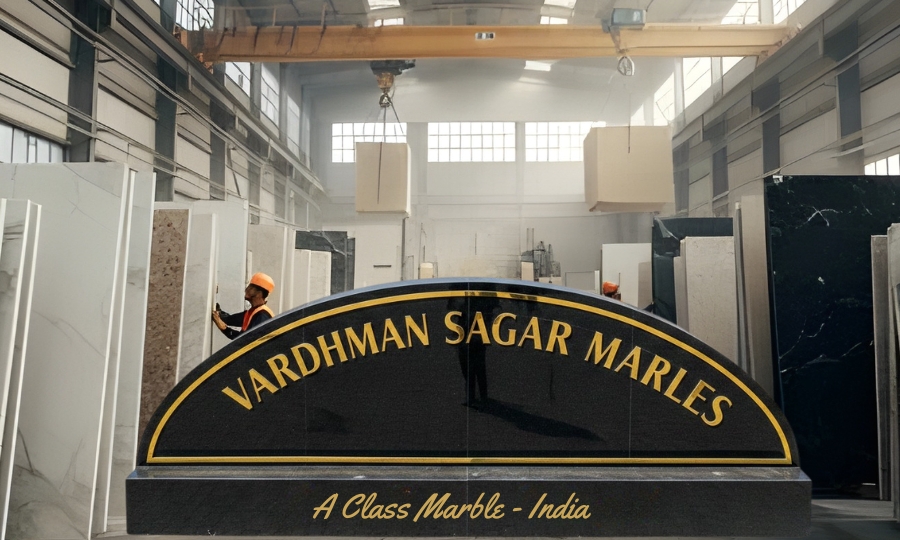
Kishangarh serves as the only location where you can get factory-direct pricing for Grade-A marbles, thus eliminating middleman mark-ups. Vardhman Sagar Marbles highlights that the quarries, cutting units, and showrooms in Kishangarh are located within close range, which reduces middleman costs and helps buyers save 20% to 40% compared to market prices elsewhere.
As reported by Incense Media, Kishangarh also has more than 1,200 marble processing units and over 1,500 showrooms. It means that you can physically inspect the entire slabs at Kishangarh. So, the best high-quality marble supplier for home in India can definitely be found in Kishangarh.
The 8 Non-Negotiable Things to Check Before Buying
Before buying Grade-A marbles, here are eight non-negotiable supplier credentials to check for ensuring quality.
Supplier Credentials & Certifications
You should verify the following key documents or credentials.
- International Organisation for Standardisation/ ISO 9001:2015: It is a premier international standard for Quality Management Systems (QMS). It demonstrates consistent product quality, reliable processes, and customer satisfaction.
- Goods and Services Tax (GST) Registration/ Business License: It confirms the legal status of the supplier as a business entity.
- Export License/ Importer-Exporter Code (IEC): It is a mandatory 10-digit identification number required for importing or exporting marbles from India.
- Industry Memberships: Credible marble suppliers tend to have industry memberships with bodies like the Chemical and Allied Products Export Promotion Council (CAPXIL), Federation of Indian Granite & Stone Industry (FIGSI), or Centre for Development of Stones (CDOS).
- Test Reports: Credible suppliers often publish third-party reports for durability, typically based on the American Society for Testing and Materials (ASTM) standards.
Verify Stone Origin & Authenticity
You must verify the authenticity of marble by requesting quarry certificates and import invoices. Import papers include the Bill of Lading and Certificate of Origin. You should also check if the veins are unique and irregular. Moreover, authentic Grade-A marble should feel highly dense and have natural coolness.
In the case of premium types of marbles like Statuario, Calacatta, or Carrara, you should inspect the white base. It must look natural, and not overly glossy, resin-filled, or waxy. Additionally, it is also important to verify the reputation of the supplier. Many marbles that appear Italian by look are processed domestically instead of being imported. Therefore, trustworthy dealers provide transparent origin details.
Conduct a Physical Slab Inspection
You should avoid making a buying decision based on the samples alone. Suppliers may send you premium samples, but end up delivering marbles of sub-par quality. A reliable way to confirm marble quality grades in India is to inspect the actual batch rather than just the display samples. Here are the aspects you should inspect.
- Surface Polish Quality: Perform a fingernail test. If the slab scratches or feels rough, it means that the polish is poor. You should look for a mirror-like shine without waves.
- Crack or Fissure Check: Use the water spray method. Cracks in marbles become highly visible when damp, revealing the quality of the stone.
- Colour and Veining Consistency: You should check 5 to 10 slabs from the same batch. A supplier of quality marbles must have slabs with uniform patterns.
- Thickness Uniformity: You can use a calliper to check if the thickness of marble is consistent across slabs. The consistency of thickness is crucial for durability.
- The Resin Test: Many Italian marbles in India are heavily treated with epoxy resins to hide cracks. Drop some water on the marble; genuine marble has low porosity and will not absorb water easily, whereas resin-filled microcracks will lead to uneven absorption.
Verify Technical Load and Chemical Resistance
You can also identify Grade-A marbles based on their technical load tolerance and chemical resistance properties.
Compressive Strength and Modulus of Rupture (MOR)
Grade-A marble has high compressive strength, generally exceeding 50 MPa and going closer to 120 MPa. This is the stone’s ability to withstand heavy furniture or high footfall without developing micro cracks. You can ask the supplier for the test reports for IS 1121 (Part I).
Grade-A slabs must have high MOR. It means that they should be able to flex under the settling of a new building without snapping. This is a common failure in lower-grade commercial stones that are brittle.
Chemical Sensitivity and Acid Reactivity
High-quality marbles are mainly calcium carbonate. However, Grade-A selections must have lower concentrations of pyrite or iron oxides. Lower-grade marbles with high iron content tend to oxidise or develop rust-coloured spots upon exposure to water or acidic cleaning agents. A-Grade marbles are more chemically stable. Consequently, the pristine whites and greys do not turn yellow or brown three years after their installation.
Abrasion Resistance/ Hardness Factor
Grade-A marble can also be identified based on resistance to wear. High-quality marbles should not show abrasive wear (Amsler test) of more than 3 mm. This ensures that the mirror finish remains intact even in entryways and hallways. Suppliers who do not provide a technical datasheet or physical property report for their lot are likely selling commercial-grade stones under premium labels.
Understand the Full Landed Cost
When purchasing quality marble, it is important to calculate the full landed cost. Never rely on the per-square-foot quote. Expenses like transportation, loading charges, wooden packaging, and GST are generally excluded from the headline price.
According to Vardhman Sagar Marbles, as of April 2026, the loading charge in Kishangarh is ₹160 per tonne, while wooden packaging adds ₹1.5 to ₹2 per square foot. An 18% GST on Italian marbles also applies. One of the best practices for buyers is to always request an itemised pro forma invoice. This will help you understand the hidden costs.
Evaluate the Range of Stones Offered
You should evaluate the range of stone offered by a supplier. If the supplier only offers one type of stone, it can mean that they lack expertise. A supplier who offers only one stone may also try to force a material that is unsuitable for your application.
A genuine A-Grade marble supplier will generally have a broad inventory. You will find varieties like Indian marbles, Italian and imported marbles, and also durable granites, luxurious onyx, and rustic sandstone.
Project needs keep evolving; meaning, you must be able to switch from marble to any other type of natural stone without having to change vendors. Moreover, projects involve the use of different types of natural stones, and not just marble. If you source from multiple vendors, you will face inconsistency in terms of quality, colour matching, and slab thickness.
Note: The Dry-Lay method is a good way of checking the stones before you buy them. A good supplier will offer a “pseudo-Dry-Lay” service where they lay out the slabs on the floor so the architect can see the “Book-match” before it is shipped.
Assess After-Sales Support and Delivery Reliability
Prioritise inspecting after-sales service and reliable delivery. You should also focus on breakage policies, expert installation support, and tracking-enabled shipping. Check if the supplier uses secure packaging that is compliant with the International Standards for Phytosanitary Measures No. 15 (ISPM-15).
Confirm if the batches of marble slab align with the samples you have approved. You should also ask about the replacement policy in case a slab is broken during transit. Moreover, it is also advised to check for past project references if available.
Sustainability & Ethical Quarrying Practices
Reputed suppliers place emphasis on the sustainability of their business practices. Top architects and premium buyers tend to look for information on the ethical sourcing of premium stones. Sustainable and ethical practices mean that the supplier is reputable and thus reliable. Here is what you should verify to understand the level of sustainability practices.
Water Stewardship
Ask the supplier if they use closed-loop water recycling for processing marbles. According to Dynamic Stone Tools, advanced filtration systems that recycle water used in cutting and polishing stones can reduce water consumption by up to 90%. It also prevents the contamination of local water sources.
Ethical and Legal Compliance
You should verify if the operations of the supplier are licensed and compliant with state mining regulations. You should also verify if the operations are free from child or forced labour.
Confirm if the quarry from where the marbles are sourced has active environmental clearances and safety certifications. It is also important to verify if the supplier has a land rehabilitation plan in place for the restoration of quarries after exploitation.
The Red Flags: 5 Signs You’re Dealing with the Wrong Supplier
Let’s talk about the red flags to avoid when choosing the supplier of A-Grade Marble in India.
| Sign | Why It Is A Red Flag? |
| No Documentation Available: The supplier is unable to provide import records, ISO certifications, or a GST number, even upon request. | Legitimate suppliers will be able to provide you with documentation that confirms the origin and quality of the marble. Lack of paperwork can mean that low-grade, locally sourced, or mixed-quality stones are being sold under premium and imported brandings. |
| Pressure to Buy Without Slab Inspection: The supplier may insist on just trusting them, push you to make a purchase solely based on small samples, and discourage you from visiting to see the full slab. | Understand that samples can be deceptive. The supplier may show you only the best part of a stone. Therefore, before making a large and high-value order, you should inspect the entire slab for cracks, colour consistency, and hidden fissures. Moreover, genuine suppliers would want their high-value clients to pay a visit. |
| Unrealistically Low Pricing Per Square Foot: You think that the prices are too good to be true. The price per square foot of a type of marble is significantly lower than the market average for it. | It is expensive to extract and process high-grade, natural marble. Which means that if the price is unusually low, it can signal inferior quality, chemical treatment, or a commercial grade. Such marbles are also more prone to staining and breakage. |
| No Clear Breakage Or Dispute Policy: The supplier avoids discussing terms or does not have written policies on breakage during transit. The supplier may also fail to take responsibility for quality issues upon delivery. | Professional suppliers would have clear terms and conditions. You are likely to find the terms directly on the website. If not available online, written terms and conditions can be requested. Unreliable suppliers try to avoid accountability once your ordered stones have left their warehouse. |
| Sample-To-Delivery Mismatch History: The supplier has a history of supplying stones that do not match the approved samples in terms of colour, veining, or quality. This can be confirmed by asking for references or checking online reviews. | Inconsistent suppliers can show you premium samples. However, they might deliver you lower-grade marbles. The slabs you receive might not at all or barely match the samples you approved. On the other hand, the received marbles might appear the same as the sample at first, but end up yellowing or changing colour after installation. |
Table 1: Red Flags To Look For In A Marble Supplier
Looking For an A-Grade Marble Supplier?
Choosing the best A-Class marble supplier for home in India requires validating material needs, inspecting slab quality, checking reputation, exploring variety, verifying support, assessing transparency, and visiting the showroom. Remember that the ideal supplier is not the one that offers inexpensive products or appears impressive. It is the one that answers questions, displays slabs physically, and provides documentation.
Before you start reviewing suppliers, ask questions about the origin of their stones and confirm the existence of the slab’s origin certificates. You should also ask for references and independently check customer ratings. Additionally, gain knowledge of the simple ways to test the authenticity of marbles, and try to understand whether they deliver the same stones as the samples you approve. If you feel ready to evaluate, start by reaching out to the best-rated marble supplier in Kishangarh today!
Frequently Asked Questions (FAQs)
1. Are Indian Marbles as Good as Italian Marbles?
Yes. Indian marble, like Makrana, is harder, less porous, and more durable. This makes them ideal for high-traffic areas. Italian marbles are softer, highly porous, and are valued for their luxurious, high-gloss, and premium feel. It means that Indian marble is more practical, while Italian marble is generally considered more beautiful due to its high lustre and unique veining.
2. Do Kishangarh Suppliers Ship Marbles Pan-India?
Yes, Kishangarh is the premier marble hub of India, and suppliers from the region offer Pan-India delivery. You will get reliable shipping for both Indian and imported Grade-A marbles.
3. What Are The Most Popular Grade-A Marbles?
The most popular Grade-A marbles include Statuario (Italy), Calacatta (Italy), Carrara (Italy), Thassos (Greece), and Makrana (India).
4. Do A-Grade Marbles Come In All Generally Available Finishes?
Yes. High-grade marbles come in the most common finishes, including polished, honed, brushed, and sand blasted. The finish depends on the type of marble and its intended application.
5. What Is A Sound Test For A-Grade Marbles?
A common sound test involves tapping the marble with a metal object, like a coin. If the marble is of high quality, it will feel dense and will be crack-free. Such high-grade marbles produce a clear, ringing metallic sound. If you tap the metal object on a low-quality or cracked marble, it will produce a dull, dead, or muffled thud sound.