
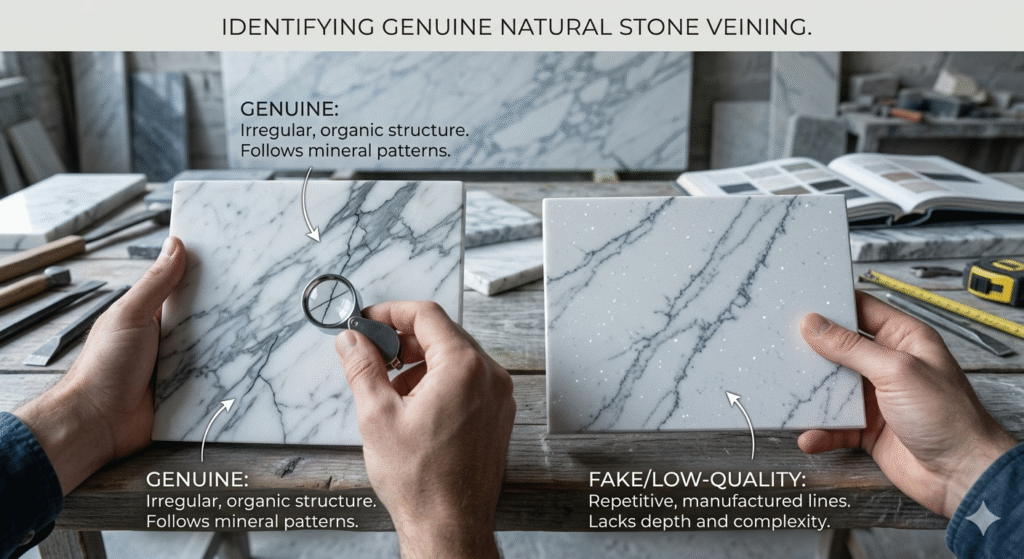
Natural stone has always been associated with luxury, elegance, and timeless beauty. Whether it is Italian marble, granite, onyx, quartzite, or travertine, genuine natural stone creates a premium look that artificial materials often fail to replicate. However, with the increasing demand for imported marble and decorative stones, the market has also seen a rise in low-quality fake stones, printed slabs, chemically treated materials, and artificial veining patterns designed to imitate real natural stone.
Many homeowners, architects, builders, and interior designers struggle to identify whether a stone is truly natural or simply a low-grade imitation. At first glance, fake stones may look attractive, but over time they often lose polish, fade, crack, or fail to deliver the richness and durability of authentic natural stone.
Understanding how to identify genuine natural stone veining is extremely important before investing in marble flooring, wall cladding, countertops, staircases, or luxury interiors. In this detailed guide, we will explain everything you need to know about natural stone veining, how fake stones are manufactured, key differences between original and duplicate materials, and practical tips to avoid buying low-quality products.
What Is Natural Stone Veining?
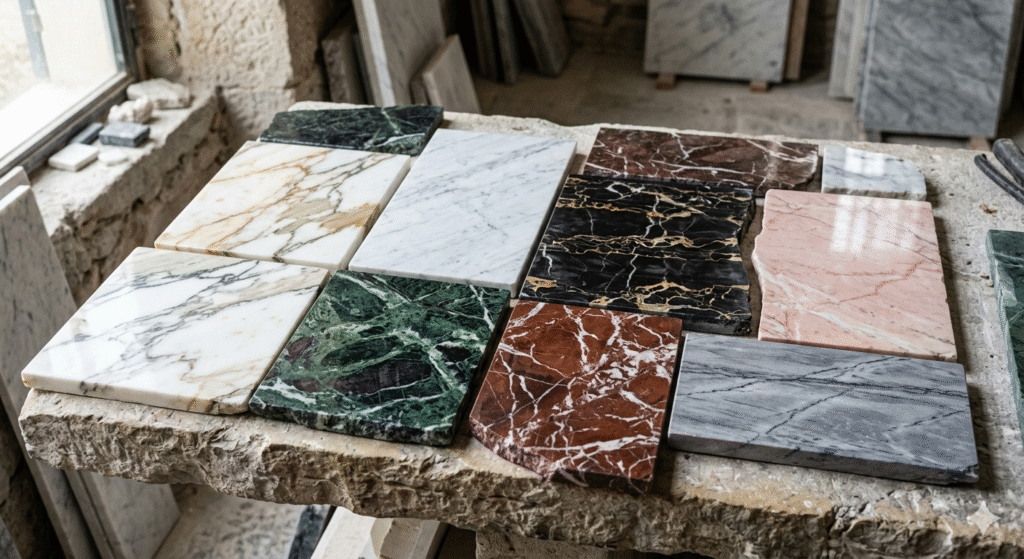
Natural stone veining refers to the unique lines, waves, patterns, textures, and mineral formations naturally created inside stones over millions of years. These veins are formed due to mineral deposits, pressure changes, heat, sediment movement, and geological activity beneath the earth’s surface.
Every genuine marble or natural stone slab carries its own distinct identity. No two slabs are exactly identical because nature creates random variations in:
- Color movement
- Vein thickness
- Mineral dispersion
- Pattern flow
- Crystal formation
- Texture depth
This natural inconsistency is actually the biggest sign of authenticity.
For example:
- Italian marble often has soft flowing veins.
- Onyx displays translucent layered movements.
- Quartzite shows mineral-rich crystalline patterns.
- Granite contains granular mineral structures.
Authentic natural stone looks alive and dynamic because the veining exists throughout the slab rather than only on the surface.
Why Fake Natural Stone Is Becoming Common
The popularity of luxury interiors has increased the demand for premium-looking marble and imported stone. Since genuine imported marble is expensive, many low-quality manufacturers create artificial alternatives that imitate the appearance of natural stone at a cheaper price.
Some common fake or low-quality materials include:
- Printed ceramic slabs
- Artificial surface coatings
- Resin-filled low-grade marble
- UV printed designs
- Engineered copies of marble veins
- Chemically enhanced stones
- Low-density composite stones
Many buyers unknowingly purchase these materials thinking they are authentic imported marble or natural stone.
The problem becomes visible after installation when:
- Polish fades quickly
- Surface becomes dull
- Veins appear artificial
- Edges chip easily
- Color changes occur
- Patterns repeat unnaturally
- Cracks develop
This is why understanding genuine natural veining is essential.
Why Genuine Veining Matters
Natural veining is not only about appearance. It also reflects the originality, quality, and long-term value of the stone.
1. Authentic Luxury Appeal
Real natural stone has depth and richness that artificial materials cannot fully imitate. Genuine veining creates a luxurious visual flow in flooring and wall applications.
2. Higher Property Value
Premium natural stone enhances the value of homes, villas, hotels, and commercial projects.
3. Long-Term Durability
Original natural stone generally performs better over decades compared to fake coated surfaces.
4. Unique Patterns
Each slab becomes exclusive because nature never creates identical copies.
5. Better Transparency and Depth
Natural veins often appear deep inside the slab rather than printed on top.
Key Ways To Identify Genuine Natural Stone Veining
1. Observe Pattern Repetition Carefully
One of the easiest ways to identify fake stone is repeated patterns.
Natural stone never creates perfectly repeated vein movements. If multiple slabs show identical veins, identical curves, or repeated patterns, it is likely artificial or digitally printed.
Genuine Stone Characteristics
- Random vein flow
- Uneven movement
- Natural variation
- Different intensity levels
Fake Stone Characteristics
- Repeated design loops
- Symmetrical patterns
- Identical slab copies
- Artificially perfect veins
Always compare multiple slabs side by side before purchasing.
2. Check Veining Depth
Authentic natural stone veins usually run through the thickness of the slab.
Look carefully at the slab edges.
In Genuine Stone
- Veins continue through edges
- Pattern penetrates deeper layers
- Natural mineral transitions are visible
In Fake Stone
- Veins exist only on the surface
- Edges may appear plain
- Printed top layer becomes visible
This edge inspection method is one of the most effective ways to identify fake marble.
3. Look For Natural Imperfections
Nature is imperfect, and that is exactly what makes genuine stone beautiful.
Real natural stone contains:
- Mineral spots
- Tiny pits
- Fossil marks
- Color variation
- Uneven crystals
- Soft texture changes
Low-quality fake stones often look excessively perfect and uniform.
If a slab appears too flawless or machine-generated, inspect it carefully.
4. Examine Light Reflection
Natural stone reflects light differently due to its mineral composition.
Genuine Stone Reflection
- Soft and deep glow
- Natural crystal reflection
- Layered visual depth
Fake Stone Reflection
- Flat glossy shine
- Plastic-like reflection
- Surface coating appearance
Premium natural marble often displays internal depth when viewed under strong lighting.
5. Check Surface Temperature
Natural stones usually remain cooler than artificial materials because of their mineral density.
Touch the slab surface.
Real Natural Stone
- Feels naturally cool
- Maintains temperature longer
Artificial Stone
- Warms quickly
- Feels synthetic
This traditional test is widely used in the stone industry.
6. Inspect Vein Flow Direction
Natural veins move organically rather than mechanically.
Observe whether the veins:
- Fade naturally
- Change thickness randomly
- Flow unpredictably
Artificial patterns often appear controlled or digitally designed.
In real marble, veins may branch out, dissolve gradually, or merge naturally.
7. Use Water Absorption Testing
Some fake stones contain heavy resin coatings that block natural absorption.
Place a few drops of water on the surface.
Genuine Stone
- Slowly absorbs moisture
- Darkens slightly temporarily
Artificial Surface
- Water remains unchanged
- No absorption occurs
However, this test should be done carefully because some natural stones are also sealed.
8. Check Backlit Transparency
Certain natural stones like onyx and premium marble exhibit natural translucency.
When backlit:
Genuine Stone
- Shows depth
- Reveals mineral layers
- Displays natural clouding
Fake Stone
- Looks flat
- Appears opaque
- Shows printed appearance
This method is especially useful for identifying original onyx.
9. Study The Slab Edges And Corners
Low-quality fake slabs often reveal their artificial composition at edges.
Inspect for:
- Surface film layers
- Printed coating
- Resin patches
- Artificial fillers
Natural stone edges should display continuous mineral composition.
10. Compare Slab Weight
Natural stone is usually heavier because of its density.
Artificial materials may feel lighter due to synthetic fillers or hollow composition.
Heavier slabs often indicate genuine mineral content.
Common Types Of Fake Natural Stone In The Market
Printed Ceramic Marble
These are ceramic or vitrified slabs digitally printed with marble patterns.
Signs
- Repeated designs
- Surface-only veins
- Uniform appearance
Resin-Coated Marble
Low-grade marble coated with chemicals and heavy resin to enhance shine.
Signs
- Excessively glossy finish
- Artificial plastic feel
- Surface scratches easily
Engineered Composite Stone
Made using crushed stone mixed with resins.
Signs
- Controlled patterns
- Uniform color consistency
- Less natural depth
Artificial Quartz Copies
Some low-cost quartz products imitate natural marble using printed designs.
Signs
- Mechanical uniformity
- No organic movement
- Identical vein structures
Difference Between Genuine Marble And Fake Marble
| Feature | Genuine Natural Stone | Fake/Artificial Stone |
|---|---|---|
| Vein Pattern | Random and natural | Repeated and artificial |
| Depth | Veins run internally | Surface-only design |
| Texture | Natural variation | Uniform texture |
| Reflection | Deep mineral glow | Flat glossy shine |
| Temperature | Naturally cool | Warms quickly |
| Slab Variation | Every slab unique | Identical copies |
| Edge Appearance | Continuous veins | Surface printing visible |
| Durability | Long-lasting | Often weaker |
Best Natural Stones Known For Beautiful Genuine Veining
Italian Marble
Italian marble is famous for elegant flowing veins and luxurious movement.
Popular varieties include:
- Statuario Marble
- Calacatta Marble
- Botticino Marble
- Dyna Marble
- Armani Grey Marble
These stones display natural sophistication and high-end aesthetics.
Onyx Marble
Onyx features dramatic translucent veining with rich color layering.
Popular options include:
- White Onyx
- Blue Onyx
- Green Onyx
- Honey Onyx
Quartzite
Quartzite combines natural beauty with high durability.
Its crystalline structure creates unique mineral-rich patterns.
Travertine
Travertine contains naturally formed linear textures and earthy movements.
Tips To Avoid Buying Low-Quality Fake Stone
Buy From Trusted Suppliers
Always purchase from reputed natural stone dealers and importers with transparent sourcing practices.
Reliable suppliers usually provide:
- Original slab selection
- Proper polishing
- Quality inspection
- Quarry information
Visit The Warehouse Personally
Never rely only on online images.
Physically inspect:
- Full slabs
- Edge cuts
- Surface consistency
- Natural variations
Real stone looks different under natural lighting.
Ask About Stone Origin
Genuine imported marble suppliers should know the country and quarry source.
Common marble origins include:
- Italy
- Turkey
- Greece
- Spain
- Vietnam
Unclear sourcing may indicate low-quality material.
Request Multiple Slab Viewing
Viewing several slabs together helps identify repeated fake patterns.
Natural stones always vary slightly.
Check Thickness Uniformity
Poor-quality fake slabs may have inconsistent thickness or hidden backing materials.
Ask About Resin Treatment
Some natural marble receives limited resin treatment for strengthening, which is acceptable. However, excessive resin coating may hide low-quality stone.
Avoid Extremely Cheap Pricing
Premium natural stone cannot be sold at unrealistically low prices.
If the price seems unusually cheap compared to market value, inspect the material carefully.
Why Natural Stone Veining Is Impossible To Fully Replicate
Nature creates stone through geological processes over millions of years. Mineral deposits, heat, pressure, and sediment movement generate unpredictable patterns that machines struggle to duplicate authentically.
Artificial manufacturers may imitate appearance temporarily, but they cannot recreate:
- Internal mineral depth
- Natural translucency
- Organic movement
- Random crystal formation
- Geological variation
This is why genuine natural stone always feels more premium and luxurious.
Common Mistakes Buyers Make
Choosing Only By Polish
High gloss does not always indicate high quality.
Some fake stones use chemical coatings for artificial shine.
Ignoring Slab Edges
Edges reveal the real composition of the slab.
Always inspect them closely.
Trusting Edited Photos
Online images are often edited with filters and enhanced lighting.
Physical inspection is extremely important.
Buying Only Based On Price
Cheap materials may lead to expensive replacement costs later.
Importance Of Professional Guidance
Architects, interior designers, and experienced marble consultants can help identify genuine natural stone more accurately.
Professionals understand:
- Vein authenticity
- Quarry quality
- Stone grading
- Surface treatment
- Long-term performance
Consulting experts before purchasing large quantities can prevent costly mistakes.
Future Trends In Natural Stone Authentication
As fake stone manufacturing becomes more advanced, the industry is increasingly adopting:
- Digital slab tracing
- Quarry certification
- Stone authenticity records
- Barcode slab identification
- AI pattern analysis
Premium suppliers are becoming more transparent regarding stone sourcing and authenticity.
Final Thoughts
Identifying genuine natural stone veining is one of the most important steps when selecting marble, granite, onyx, quartzite, or other luxury stones for your home or commercial project. While fake materials may initially appear attractive and affordable, they rarely match the elegance, durability, depth, and long-term value of authentic natural stone.
Real natural stone tells a geological story through its veins, mineral formations, and unique patterns. No two slabs are ever truly identical, and that individuality is what creates timeless luxury.
Before making a purchase, always inspect the slab carefully, study the vein movement, check the edges, observe pattern variations, and buy only from trusted suppliers. A little extra attention during selection can save you from expensive disappointments and ensure that your interiors maintain their premium appearance for years to come.
If you are investing in imported marble or luxury natural stone, understanding genuine veining is not just helpful — it is essential for making the right decision.